
Cloud Applications – A New World with AI
For decades, custom software was a luxury reserved for large corporations with deep pockets. The development of a bespoke Software as a Service (SaaS) and Cloud Applications required large, specialized teams and lengthy, expensive development cycles, placing it firmly out of reach for most small and medium-sized businesses. This has changed. And radically so… (Click to read more)
Today, that paradigm has been shattered. The rise of sophisticated Artificial Intelligence is a democratizing force, leveling the playing field and ushering in an era of unprecedented accessibility. AI-powered tools now act as expert co-pilots for developers, revolutionizing the entire creation process. By automating repetitive code, identifying potential bugs in real-time, optimizing database structures, and even generating entire functional components, AI handles the granular, time-consuming tasks.
This radical efficiency does more than just speed things up; it fundamentally changes the economics of software development.
What this means for your business is transformative. The barrier to entry has crumbled. Custom-fit SaaS applications or purchased Cloud Applications, designed to perfectly match your unique operational workflow, are now more affordable, built faster, and are of a higher quality than ever before. This is your opportunity to deploy enterprise-grade tools that streamline operations, eliminate bottlenecks, and unlock a powerful competitive advantage that was previously unimaginable. The future of business software isn’t just for the Fortune 500—it’s for you.
The AI Advantage: Faster Timelines, Leaner Teams, Lower Overheads
The impact of AI on software development isn’t just incremental; it’s exponential. It redefines what’s possible in terms of speed, team structure, and cost. (Click to read more)
Slashing the Development Timeline
AI-assisted programming can reduce the time from concept to a functional prototype by an estimated 30-70%. Tasks that traditionally took days of manual coding can often be accomplished in hours. This acceleration means your business gets the tool it needs faster, allowing you to adapt to market changes with incredible agility.
| Metric | Traditional Development | AI-Assisted Development |
| Initial Prototype | Weeks to Months | Days to Weeks |
| Core Feature Build | Months | Weeks |
| Iteration & Testing | Slow, manual bug-hunting | Faster, with AI-assisted debugging |
The Rise of the Lean, Expert-Led Team
The era of needing a massive team of developers to build a quality SaaS product is over. The new model for success is small, agile, and expert-driven.
A single senior Systems Architect—a professional who deeply understands business processes, user experience, and high-level strategy—can now leverage AI as their dedicated coding team. The architect focuses on the critical elements: designing the perfect workflow, ensuring the software solves the right business problems, and planning for future scalability. The AI handles the heavy lifting of writing the clean, standardized code to bring that vision to life.
This lean structure means:
- Drastically Reduced Overheads: No large payrolls or corporate bureaucracy.
- Direct Communication: You work directly with the architect who is designing your system.
- Unmatched Agility: The team can pivot and adapt to your feedback instantly.
The Critical Difference:
Architect-Directed vs. “Vibe”-Driven Development
The arrival of AI has lowered the barrier to entry for software creation, but it has also introduced a hidden danger for businesses: the rise of “vibe”-driven development. Understanding the difference between this and a professional, architect-led approach is crucial to the success of your project. (Click to read more)
The “Viber”: The Illusion of Progress
A “viber” is a developer who uses AI as a crutch, not a tool. They follow a path of least resistance, prompting AI to generate code that looks functional on the surface, based on a general “vibe” or a surface-level understanding of the goal.
This approach lacks a foundational blueprint. It neglects the critical, invisible structures that define professional software: robust data architecture, long-term scalability, security protocols, and a deep understanding of the underlying business process.
The result is a “house of cards” application. It may work for a simple demo, but it will crumble under the weight of real-world use, proving incredibly costly to fix and impossible to scale.
The Architect: The Foundation of Success
The process is strategy-first. Before a single line of AI-generated code is written, the architect:
- Maps your entire business process to identify true needs and bottlenecks.
- Designs a logical, secure, and scalable database structure.
- Creates a comprehensive architectural plan for the entire application.
Only then is AI leveraged to execute this well-defined plan, rapidly building components that are already designed to work together perfectly. The architect’s expertise guides the AI, ensuring the final product is not just functional, but robust, secure, and a lasting business asset.
Solving Old Problems with a New Model
This architect-led model also solves two of the most persistent problems in traditional software development:
- The “Maverick Genius”: A brilliant developer who produces code so complex and undocumented that no one else can maintain it, creating a dangerous single point of failure.
- The “Code Hacker”: A developer who strings together an application using disjointed protocols and temporary “band-aid” fixes, resulting in an unstable and insecure product.
Proper direction of AI prevents these issues from the start. It enforces a standardized, best-practice approach across the entire project. Think of AI as a top-grade developer with near-infinite experience, constantly at hand. However, this expertise is only effective when it is orchestrated by a strategic architect who ensures every piece serves a single, coherent vision.
At a Glance: The Two Approaches
| Aspect | The “Viber” (High Risk) | The Architect (Professional) |
| Foundation | No blueprint; code is “stitched together.” | Starts with a detailed architectural plan. |
| Data Structure | Disorganized, inefficient, and insecure. | Logical, scalable, and secure by design. |
| Process | Asks “What should it look like?” | Asks “How must it work, now and in the future?” |
| Tool Usage | Lets the AI lead. | Directs the AI to execute a specific task. |
| The Outcome | A fragile app that is expensive to fix. | A robust asset that grows with your business. |
The choice is clear. The most exciting promise of AI is not that anyone can build an app, but that an expert can now build a world-class app for you with unprecedented efficiency and value.
Current Development Pipeline: Case Studies
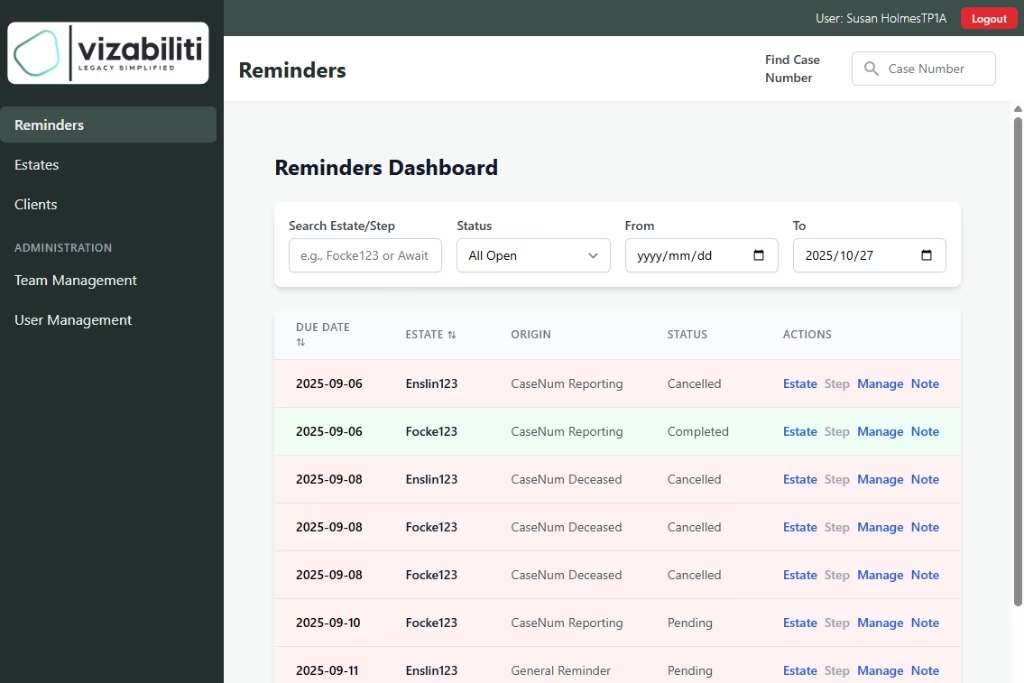
Case Description
The execution of deceased estates is shared by several entities each fulfilling a specific role. One of the key roles here is that of the Tax Practitioner who by law is the only entity allowed to liaise with the SA Revenue Services around deceased estates. They form the bridge between the Executors and Attorneys and SARS. This entails a disjointed and bewildering range of loose however still related tasks involving coordination of documents, target dates and escalations. Many of these tasks have specific turnaround times between submission to SARS and standard target dates for follow up. Some aspects resemble a workflow system while others are simply coordinating the prerequisites for various document packs involved. The main purpose of the system is that of efficiency to ensure that each estate is handled as quick as possible by SARS personnel.
The traditional way of handling this employs several applications from spreadsheets, notes, word documents, email and calendars. Finding referenced documents on the run to handle enquiries, is a nightmare.
Goals for System
- Make the system easy to use with a simple, clear layout.
- Provide intuitive context sensitive flow through the system.
- Make various pieces of info readily available. Limit clicks by focusing on the context of each task to prevent wastage of even seconds.
- Construct a robust database to coordinate the wide variety of operational demands while allowing targeted searching and timely reminders.
- Ensure privacy between subscriber data silo’s and even between various teams in a subscriber.
- Cater for various subscribers (Tax Practitioner companies) allowing for teams structure with data sharing in a team.
- Allow various user levels responsible for managing teams, creating estates and managing estates.
- Allow for transfer of estates between teams and also team members between teams to allow extra people where pressure is highest.
- Allow very precise target dates, notes and recording of Case References given by SARS during the life cycle of each estate.
- Allow for detailed reporting to Executors, Attorneys and the Tax Practitioner regarding SLA’s and performance.
Design Considerations
- Security-First Architecture: Implemented a multi-layered security model using token-based authentication and granular, role-based permissions. This ensures absolute data privacy between subscribers (data silos) and even between different teams within the same company, which was a core project goal.
- Decoupled & Performant Foundation: Utilized a modern decoupled architecture with a Laravel 11 API backend and a Vue 3 Single-Page Application (SPA) frontend. This separation ensures high performance, a fast and responsive user experience, and allows the system to be scaled efficiently in the future.
- Maintainable & Scalable Codebase: Built upon a foundation of industry best practices to ensure long-term stability. Key patterns like layered API services, reusable components (DRY principle), and standardized coding styles mean the system is robust, easy to maintain, and simple to extend with new features.
- Architect-Led, AI-Assisted Development: The system’s robust architecture was designed first, focusing on the business logic, data integrity, and user workflow. AI-assisted tools were then leveraged to rapidly and accurately build out standardized components within this pre-defined framework, ensuring both development speed and exceptional code quality.
- Data Integrity and Reliability: Selected PostgreSQL as the database for its proven reliability and strict data-typing rules. Authorization policies were implemented at the controller level to protect individual records, guaranteeing that users can only interact with data they are explicitly authorized to access.
- Intuitive User-Centric Interface: The frontend was built as a Single-Page Application (SPA) using Vue 3 and Pinia for state management. This provides a seamless, app-like experience for users, allowing them to navigate and manage complex estate data without constant page reloads, fulfilling the goal of an efficient, context-sensitive workflow.